War
Museum
During the Second World War, the underground of Naples was further altered to shelter the population during the air raids.
During the war years some 40,000 people lived in the city’s underground spaces, waiting for the conflict to allow a return to life.
But the destruction caused by the war presented a shocking scene to the people as they left the protective belly of their native city: the ferocious bombing had destroyed much of the city.
Even in the painful and laborious reconstruction of Naples, its hollow belly played its part: the lack of means of transport was solved by throwing the debris down the ancient wells.
The heaps of broken tuff to which the city had been reduced were thrown back inside it, into the very place from which, over the centuries, they had come.
The substratum continued to be used as a dump and, until the 1980s, its history lay buried under rubbish.
It is only thanks to the work of a number of volunteers, who decided to clean up the foundations of the city, that Naples can today offer an astounding route which, through time and history, gives tourists a journey that would be impossible anywhere else.
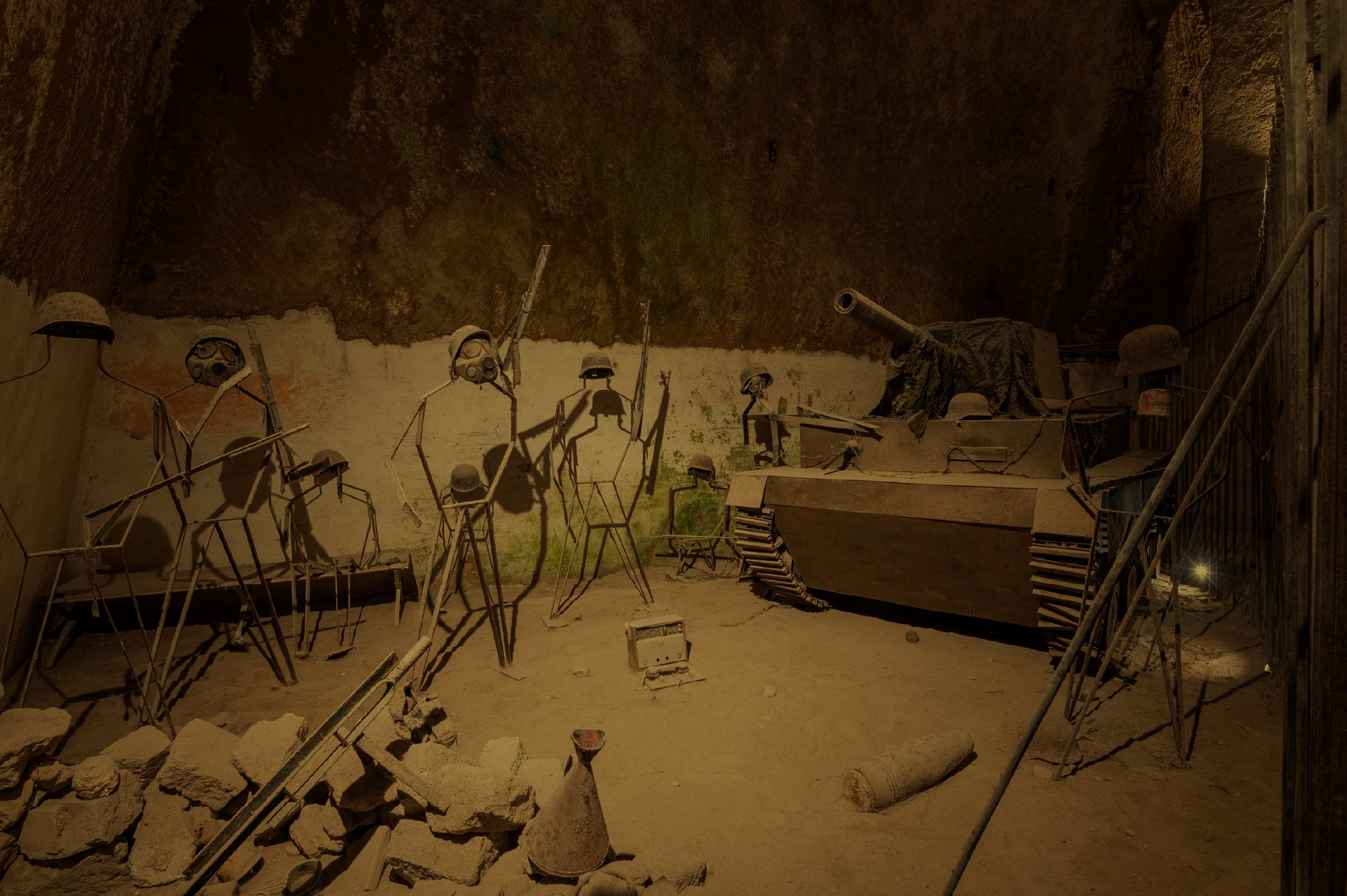
The Napoli Sotterranea War Museum collects and preserves documents relating to the Second World War, including materials, objects and documents from the period between June 1940 and September 1943.
At the end of the visit to Napoli Sotterranea, visitors will be taken to the rooms dedicated to the War Museum.
For visitors, passing through the Museum is an immersive and moving experience that is one of a kind, a leap into the past to discover times gone by.
Since March 2008 the War Museum of Naples has been committed to collecting and preserving documents relating to the Second World War.
You can see the display of materials, objects and documents from the period between June 1940 and September 1943.
In 1940 Italy suffered its first air raids by the British, which could have been justified as a reaction to the Germanic barbarity of the violent bombing raids by the Luftwaffe (the German air force).
According to well-accredited historical sources, it appears that the first night-time bombing of non-military targets was carried out by the British in May 1940 on the wonderful city of Freiburg.
The raids then continued throughout 1940 on the (industrial) North and on ports or military installations (Naples); there followed a period of calm until the summer of 1942.
In March 1943 an episode that remains partly mysterious was the explosion of the Caterina Costa, a merchant ship of 8,060 tonnes.
The ship was moored in the port at the place known as Ponte della Maddalena and was completing the loading of petrol, weapons and ammunition for the troops stationed at Bizerte in North Africa.
On the afternoon of 28 March 1943 something or someone started a fire that soon reached the holds – an apocalyptic explosion: the ship was blown to pieces, the blast hurled burning debris all around, causing collapses and devastation, and parts of the ship reached the Vomero hill, Piazza Garibaldi, Piazza Carlo III, the Carmine and, further still, even Bagnoli.
It was sudden, swift and violent, and the victims were very many: 600 dead and over 3,000 injured.
Tragic and terrifying, the air raids resumed after the occupation of the Italian “possessions” in Africa: as it was no longer possible to counter them, the attacks fell with devastating effect on the southern cities, first by the RAF (Royal Air Force) and then by the U.S.A.F (United States Air Force), to destroy the German lines of defence, also in anticipation of an Allied landing at Salerno.
On 4 August 1943, Naples was hit from high altitude with incendiary bombs that caused the almost total destruction of the beautiful fourteenth-century church of Santa Chiara.
In total the city endured 43 hours of bombing, with over 20,000 dead and 80% of its buildings destroyed.
History of the Four Days of Naples
by Franco Capuano
(Information taken from “Cronistoria del 25 Aprile 1945”, Feltrinelli, Milan)
Naples was a city destroyed, emptied, deserted, yet indomitable.
Indeed, the round-up of some 18,000 men by the Germans to be sent to labour camps, the evacuation of the entire coastal strip and the systematic destruction of various industrial installations led the city to rise up.
The incredible order of the Italian High Command to the few garrisons that remained: “Try to stall, do not irritate the Germans and treat the British well, as they are about to arrive”.
Despite the prevailing disorder, many servicemen, officers and soldiers, together with civilians, resisted the German troops, forcing them into outright guerrilla warfare.
Throughout the city, from Via S. Brigida to Palazzo Salerno, to the Vittoria tunnel and Via Foria, from Porta Capuana to C.so Umberto at Via Duomo, men, women, boys, soldiers and sailors proved their heroism in a hundred acts of daring.
The spark of revolt had fired people’s spirits; on 1 September 1943, at the inauguration of the academic year, Professor Adolfo Omodeo addressed his audience with these words: “Students, in this bitter moment, the University opens its arms to you; your teachers belong to the generation of the Carso and the Piave”.
On 13 September the notorious proclamation of the German Command was published, signed by Col. Scholl; from that same date a state of siege was in force: a curfew from 20.00 to 06.00, threats of severe reprisals against the population in the event of any attack on German forces, even an unarmed one, and immediate execution by firing squad for anyone found in possession of weapons.
The Germans’ anger at the failure of the call-up for compulsory service was expressed in the order posted around the city on 26 September; Col. Scholl himself cried sabotage, threatening shootings and immediate deportation for those who failed to comply. Indeed, across 4 districts of the city only 150 people answered the call, whereas according to the civil register there should have been over 30,000.
On 27 September the round-up began, a real manhunt: the streets were blocked and all the men, regardless of age, were forced onto lorries to be deported.
One of my father’s brothers was rounded up too: he was 12 years old. But when they reached Piazza Carlo III, like a true Neapolitan, he distracted the soldier on guard, jumped off the lorry and fled into the nearby alleys.
By now the Neapolitans had no other way of escaping deportation; they had to fight, on the 28th, in the early hours of dawn: armed as best they could, they began the first skirmishes. The news that a sailor had been shot dead with a revolver while quenching his thirst at a drinking fountain was the trigger for the insurrection;
a group of very young men attacked a military truck stationed in Piazza Medaglie d’oro, setting it on fire and taking its occupants prisoner.
And so, without organisation or strategy, the people rose up in a single blaze, aware of their logistical inferiority but certain of victory, because everything was dictated by the will of the people.
And so in those days officers of the Royal Army reappeared and joined the struggle alongside members of the anti-fascist parties and, with them, artists, writers and poets.
In those four frantic days Naples offered up in sacrifice one hundred and sixty-eight of its finest sons, nineteen of them unidentified, as well as an unknown number of wounded.
At dawn on 1 October 1943 the German troops abandoned the city, dejected and humiliated but furiously intent on reprisal; when the Allies arrived they found a city prostrated by suffering but proudly free.
Posthumous gold medal:
Gennaro Capuozzo (aged 12), Filippo Illuminati (aged 13), Pasquale Formisano (aged 17) and Mario Meneghini (aged 18). Posthumous silver medals to Giuseppe Maenza, Giacomo Lettieri; silver medals to the leaders of the revolt Antonino Tarsia, Stefano Fadda, Ezio Murolo, Giuseppe Sances; bronze medal to Maddalena Cerasuolo, Domenico Scognamiglio and Ciro Vasaturo.