The visit includes:
1)Greek-Roman aqueduct / medieval tunnels / Bourbon tunnels / modern tunnels Going down 136 low, easy steps, we will reach a depth of approx. 40 m, where we will visit some of the tuff cavities dug out in Greek times (4th century BC), used as cisterns to supply our city with water for around 23 centuries and later turned into air-raid shelters during the Second World War.
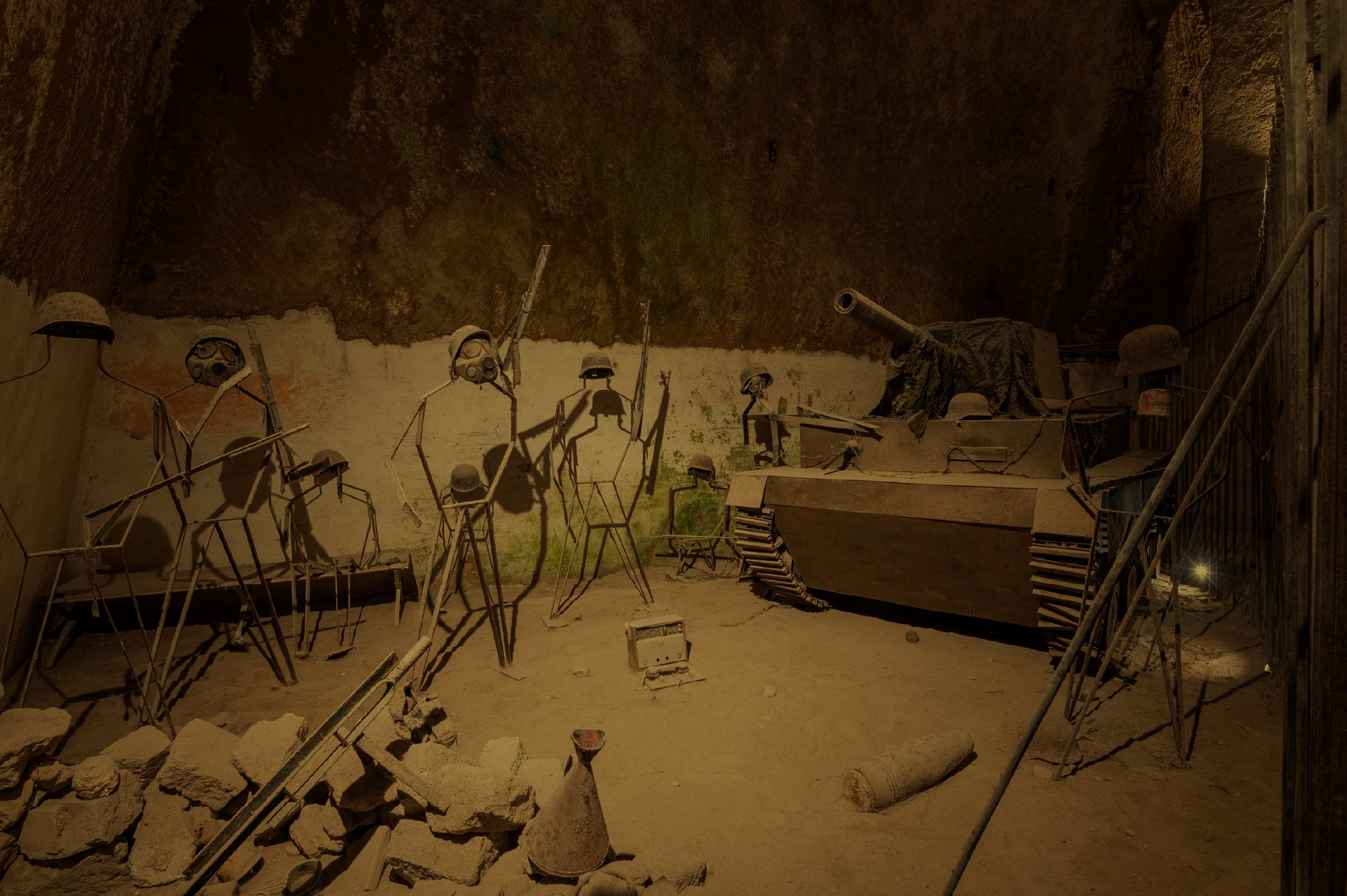
Along the route you will visit the scientific laboratory that houses the “Arianna” seismic station, the greenhouse, the Hypogeum Gardens and the War Museum.
All the spaces you pass through are large and well lit, apart from one very short stretch, which is optional but full of atmosphere, as it is lit by candlelight and leads to the Roman cistern filled with water. The ground underfoot is also even and the path straight. The visit lasts around one hour in total.
You will also visit, free of charge:
1)Visit to the remains of the Roman Theatre, absorbed into later buildings.
A visit to part of the Roman Theatre of Naples, which in the 15th century was absorbed into the houses that stand today in Via Anticaglia, Vico Cinquesanti and Via S. Paolo. We will enter a typical Neapolitan dwelling, commonly known as a “basso” because it lies at street level, and there we will already find ourselves inside the Roman Theatre.
You need only move a bed and open a trapdoor to reach other rooms where Nero had his private dressing rooms whenever he came to stage his performances in Naples.
The visit lasts around 20 minutes.
2)Summa Cavea We have recently extended the route with a new discovery. In an old carpenter’s workshop, another fragment of the theatre has come to light; inside it we have set up a permanent exhibition of some thirty antique display cases in dark wood, holding scenes from the Nativity and the traditional Neapolitan crib.
All around, opus reticulatum and latericium. We are in the intrados of the Summa Cavea of the Greek – Roman Theatre in Vico Cinquesanti, behind Piazza San Gaetano, the ancient agora of Neapolis.
Inside the newly revived section of the Roman Theatre, a further discovery has also been made.
Small channels ran through the floor, completely blocked by the waste material produced by the circular saw.
During cleaning, sewer drainage channels from the Bourbon era came to light, made with “riggiole” tiles decorated with blue patterns.
These channels have been protected with grilles and can be seen.
Hypogeum Gardens We have recently extended the route with a new project. In the darkness beneath Naples, 35 metres underground, there is life.
Among the many educational and scientific activities that Napoli Sotterranea offers its visitors are the Hypogeum Gardens.
The initiative began on the eve of Expo 2015 Milan, dedicated to feeding Planet Earth: a vegetable garden in the bowels of the earth.
An environment that only seems hostile, yet is far from acid rain, polluting fine particulate matter, smog and micro-organisms that are also harmful to human life, and so protects the classic vegetable-garden plants grown here.
For some time now, small vegetable plots have been taking the place of the usual ornamental plants on our balconies – not just as a passing fashion but also, and above all, out of a need to bring to our tables some of nature’s produce free from the inevitable human tampering.
A growing awareness of how far the quality of the ecosystem in which food crops are grown determines the quality of what we eat prompted Napoli Sotterranea to begin a phase of botanical experimentation in its underground spaces.
An underground world with its own gardens, open not only to Italian and international visitors, students, young and not so young alike, but also to university researchers and botanists who use the Hypogeum Gardens for scientific research.
So it is not just an educational resource but a chance to observe at first hand how crops grow and develop underground without natural light.
The humidity of the air and of the soil, along with its pH, the ambient temperature and, more generally, the microclimate are constantly monitored and compared with the climate readings taken outside.
Sunlight, a key element in photosynthesis, is replaced by the light of special lamps, which ensure that molecules of carbon dioxide and water are converted into glucose, which nourishes the plants, and oxygen, which passes from the leaves into the surrounding air.
Napoli Sotterranea’s Hypogeum Gardens project is attracting scientific interest from both national and international bodies.
Growing interest in the search for extraterrestrial life and in the possibility of making human settlements beyond planet Earth a reality has led NASA (National Aeronautics and Space Administration) to follow closely and with interest the progress of the studies in underground botany carried out by Napoli Sotterranea and the research bodies taking part – precisely because humankind’s expansion beyond Earth cannot succeed unless the colonies on these new frontiers are also self-sufficient in food.
Our route is authorised and therefore all safety regulations are observed and guaranteed.
The Napoli Sotterranea Association’s one and only site is at Piazza San Gaetano, 68.
The official route of the Napoli Sotterranea Association starts from Piazza San Gaetano, 68.
It is an authorised route operating under a valid concession.
Any underground tour starting from anywhere other than the place indicated is not run by our association.
The official entrance of the Napoli Sotterranea Association is at Piazza San Gaetano 68 only.
The entrance is marked by white and blue flags.
No, it is not dangerous.
The candlelit route is unlit only in certain stretches. Using a candle is not compulsory.
If you prefer, you can use a torch or your mobile phone.
We do not give candles to children.
School groups are therefore required to bring a small torch.
In any case, a minimum distance between one person and the next must be kept while walking through the tunnel.
No. The Napoli Sotterranea Association is a private organisation: the Italian legislation providing free admission for people with disabilities applies to state museums and sites (D.M. 11/12/1997 n. 507) and does not automatically apply to private organisations.
We nevertheless guarantee equal treatment, accessibility and assistance during the visit, in compliance with L. 67/2006.
You may present the European Disability Card as proof of your condition: wherever possible, we apply a reduced rate for people with a recognised disability, based on the percentage (more than 75%).
The concession is applied on presentation of the Disability Card or an equivalent certificate and entitles you to skip the queue even if you have not bought a ticket online.
Under no circumstances is the accompanying person entitled to free admission or a reduced rate.
We do everything we can to welcome every visitor, which is why we ask you to contact us before your visit so that we can give you tailored information on the accessibility of the route and on the rate.
Please note that the site has stairs and narrow passages, owing to the original nature of the underground route, and is not accessible with wheelchairs or walking frames.
No, we do not take bookings for groups of fewer than 15 people.
Booking is compulsory only if you would like to take the tour in a language other than Italian or English, if there are fewer than 15 of you but you would like a guide exclusively for your group, and for groups of more than 15 people.
Booking is also compulsory in all cases for the Thursday evening tour at 21.00.
route
Yes, our concession is displayed on the homepage.
Our route starts from Piazza San Gaetano 68, but nowadays there are several routes giving access to the network of underground spaces, which is still not fully known and in which cisterns and quarries, tunnels and wells, remains from the Greek-Roman period and catacombs follow one another; the passages linking different points of the city, some of them kilometres apart, are countless.
The earliest traces of underground excavation date back around 5,000 years, almost to the end of the prehistoric era. Later, in the 3rd century BC, the Greeks opened the first underground quarries to extract the blocks of tuff needed for the walls and temples of their Neapolis, and dug out numerous chambers to create a series of underground burial sites.
In 1987 Enzo Albertini, speleologist and president of the Napoli Sotterranea Association, brought to light a Greek quarry around 40 metres below ground, beginning the first exploration of the Naples underground.
The network of underground tunnels beneath Naples is not complete and in many places the routes do not meet; even so, whole sections of the underground dating from the Greek, Spanish and Bourbon periods can be seen.
Along our route there are clear, recognisable signs that can be traced back to the Bourbons, which makes our tour one of a kind.
for
visitors
Yes.
The route is easy to walk and the steps are very low. There are handrails along the stairs.
No, the spaces are large.
The only narrow tunnel is an optional part of the route.
Anyone who suffers from claustrophobia or is overweight and does not wish to go through the tunnel can wait for the group outside it.
The wait is around 10 minutes.
The route is made up of very large spaces. The only narrow section is a tunnel, but it is optional.
Anyone who does not feel up to going through it can therefore wait outside.
There are also benches outside the tunnel where you can sit while waiting for the rest of the group.
The wait is around 10 minutes.
Yes, of course.
There is no reason not to visit with children, even very young ones.
No, that is not possible.
You have to go down 121 low, wide steps to reach the underground. There are no lifts or escalators.
You can leave your pushchair at the main entrance and collect it on your way out.
You may bring only a small bottle of water with you.
here
From the Central Station (Piazza Garibaldi): Metro Line 1 – towards Piscinola – Dante stop.
Continue along Via Port’Alba, Via San Pietro a Maiella, Piazza Miraglia, Via Dei Tribunali – Piazza San Gaetano.
From Capodichino Airport: 250 m from Terminal 1 (opposite Banco di Napoli) take the ANM ALIBUS bus – Piazza Garibaldi stop – Metro Line 1 – towards Piscinola – Dante stop.
Continue along Via Port’Alba, Via San Pietro a Maiella, Piazza Miraglia, Via Dei Tribunali – Piazza San Gaetano.
From the Port: Make your way to Piazza Municipio – Via De Pretis – Bus Line R4 towards Ospedale Cardarelli – Piazza Dante (4th stop) – Continue along Via Port’Alba, Via San Pietro a Maiella, Piazza Miraglia, Via Dei Tribunali – Piazza San Gaetano.
The historic centre lies within the ZTL – Zona a Traffico Limitato (limited traffic zone), so you can park in Via Duomo, Corso Umberto, Piazza Cavour and Via Costantinopoli, where there are paid car parks or council-run pay-and-display spaces.
From there, Napoli Sotterranea is an easy walk away, taking 5 minutes at most.